Bake Sicilian Sfincione With a Crisp, Fried Bottom
A thick, spongy square baked the Palermo way, with a crisp olive-oil-fried bottom under a cooked-down onion, anchovy, and toasted breadcrumb top.
Your sfincione keeps coming out wrong: dense and bready instead of spongy, with a pale, soft bottom that never crisps. We've pulled plenty of flat, gummy squares from our own oven before sorting it out.
Real Palermo sfincione is its own thing: a thick, focaccia-like base under a cooked-down onion and anchovy sauce, caciocavallo, and toasted breadcrumbs. No mozzarella, that's the tell, and it isn't the US Sicilian style pizza slice. This Sicilian pizza recipe gets you that spongy crumb and a crispy bottom.
Ingredients
Think of the list below as a recipe for Sicilian pizza dough plus the distinctive Palermo top. We've dialed in this Sicilian style pizza recipe over dozens of bakes and more than ten years on a wood-fired oven, and every ingredient in the sfincione recipe earns its spot.
Bread or high-gluten flour (about 400 g / 14.1 oz): This is the backbone. Bread flour runs around 12.5% protein, and high-gluten flour like King Arthur Sir Lancelot runs near 14%. That protein builds the gluten net that traps gas and holds the open, airy crumb. We grab bread flour here when we restock.
Fine semolina (about 100 g / 3.5 oz): Semolina is flour milled from hard durum wheat. A blend adds golden color, a faint nutty flavor, and a little bite. Keep it to roughly 15 to 20% of the flour. More than that and the crumb goes dense and crumbly, which we'll come back to.
Lukewarm water (about 390 g / 13.8 oz): That's roughly 78% hydration, meaning water at 78% of the flour weight. The extra water turns to steam in the bake and blows the crumb open into a spongy, focaccia-like texture. It also makes a sticky dough, so we fold instead of fighting it.
Instant yeast (4 g), fine salt (10 g), olive oil, a pinch of sugar: The standard dough team. Olive oil pulls double duty here. A little goes in the dough for a soft crumb, and a generous pour goes in the pan to fry the bottom crisp.
Caciocavallo, or aged provolone (about 150 g): Caciocavallo is the authentic strong, stretched-curd Sicilian cheese, traditionally Ragusano. Can't find it? Use aged provolone, the closest sub, then primo sale, pecorino, or parmigiano. No mozzarella, that's the authentic Sicilian pizza marker.
Anchovy fillets (6 to 8): They melt down and carry the salty, savory backbone of the whole pie. Some coastal Palermo versions swap in fresh sardines. Not a fan? Capers or olives give you a briny stand-in.
The onion soffritto sauce: This is what separates true sfincione from a New York slice. A soffritto is just onions cooked down slowly in olive oil until soft and sweet. We add tomato, oregano, and a melted anchovy or two, then simmer it to a thick, spreadable paste. Cooked down, not raw.
Toasted breadcrumbs (muddica) for the top: Muddica is the Sicilian word for the toasted breadcrumb crown. We toast crumbs from stale bread in olive oil with a little grated hard cheese and oregano until golden. They soak up surface oil and crisp into a textured canopy.
Optional, diastatic malt powder (about 1% of the flour): Diastatic malt carries enzymes that free up a little extra sugar for browning. It earns its keep in cooler home ovens and after a long cold rise. A little goes a long way, so cap it around 1%.
For the authentic Palermo build, the cheese goes under the sauce, not on top. If you want it truly authentic, top it the Palermo way: cheese under, cooked sauce, then breadcrumbs. That cheese-under order protects the crumb and is part of what makes it real sfincione.
Why Your Sicilian Pizza Turns Out Dense Instead of Spongy
Your Sicilian pizza turns out dense instead of spongy usually because the dough is too dry, overloaded with semolina, handled too hard, or rushed. Sfincione means "thick sponge," so the goal is the light, open, airy crumb a real Sicilian crust pizza is known for. Below are the four culprits, and the fix for each.
1. The dough was too dry
If your crumb is dense and bready, the dough was probably too dry, so push the water up. We run our dough around 75 to 78%, wetter than a standard 60 to 65% pizza dough. The extra water flashes to steam in the oven and forces those big airy holes open.
Respected recipes span a wide band. Sip and Feast bakes at 64%, Andrew Janjigian runs near 83%, and Alexandra Stafford goes to 88%. So 75 to 78% sits comfortably in the spongier part of the range rather than being a hard rule.
2. You used too much semolina
If the crumb comes out dense and also crumbly, you likely used too much semolina, so dial it back to 10 to 25% of the flour. A ratio you'll see passed around pushes semolina to around 40%, and we get why it's tempting for that rustic flavor.
The catch is that durum doesn't build gluten the way bread flour does. So 40% trades away the rise and structure and leaves you with a drier, more crumbly base. We keep ours near 20% and let the bread flour carry it.
3. You handled the dough too hard
If the dough fights you and snaps back out of the corners, you are working it too hard, so stop pulling. Forcing a sticky dough degasses it and guarantees a dense result.
We fold the dough a few times in the bowl instead of kneading it hard, then ease it into an oiled pan with our fingertips. When it springs back, we wait about ten minutes and try again, letting it relax into the corners on its own time instead of tearing the gluten.
4. You rushed the rise
If you baked the dough young without a long rest, you rushed the rise, and a tight, dense crumb is the result. So give it a long cold rise. We cover ours and let it ferment in the fridge for 24 to 72 hours.
The slow cold ferment builds a fuller, tangier flavor, and it lets a high-hydration dough fully soak up its water without a lot of oxidizing kneading. Pull it out, proof it in the pan 2 to 4 hours, and bake when the top is jiggly and bubbled.
How to Get a Crispy, Fried Bottom on Sfincione
To get a crispy, fried bottom on sfincione you have to manage moisture and pour heat into the base. So cook the sauce down, set the crust before the wet toppings go on, and bake on a hot, conductive surface. A pale, soft underside is the most common complaint we hear, and every fix below targets it.
Cook the sauce down to a paste
If the crust went soggy, your sauce was too wet, so cook it down to a thick paste before it ever touches the dough. We reduce the onion soffritto until it mounds on a spoon.
The reason is simple physics. While free water sits on the surface, that surface is stuck near 212°F and just steams the crust. Browning, the Maillard reaction that builds flavor and color, needs a drier surface near 280 to 330°F, which a watery sauce never lets you reach.

Par-bake the bare base, or let the cheese be the lid
If the top scorches before the middle sets, or the interface turns gummy, set the crust first with a par-bake, or hold the wet toppings back. We par-bake the bare base about 10 to 14 minutes so the starches gelatinize into a moisture-resistant floor before the sauce goes on.
America's Test Kitchen and King Arthur both lean on this, and both note that melted cheese acts like a lid that traps steam, which is why the authentic cheese-under-sauce order helps. Check the actual bottom, not the clock, since ovens and steels vary.
Use a thin, conductive pan, not glass or ceramic
If you baked in a glass or ceramic dish and the bottom stayed pale, that's your culprit, so switch to a thin, dark metal pan. Glass conducts heat at roughly 1 W/m·K, which makes it an insulator, basically a blanket between your heat and your dough.
A thin hard-anodized aluminum pan, the kind sold as a 14x14 Sicilian pan, passes heat straight through to the base instead of buffering it.
Bake the pan on a preheated steel
The single biggest upgrade for a crispy bottom is to set the oiled pan on a fully preheated baking surface. We slide our pan onto a screaming-hot steel that has been preheating for the better part of an hour.
Doppio Living's 16" x 14.25" x 0.25" carbon steel ($99.97 on Amazon, pre-seasoned, Made in USA) is a plate of A36, a common structural carbon steel. It conducts heat at roughly 50 W/m·K.

That's about 18 to 20 times faster than a cordierite stone, and far faster than oven air or a glass dish, so it fries the bottom crisp instead of leaving it pale. A 14x14 pan sits right on it. Grab the steel on Amazon here.
One catch worth understanding. If the bottom won't brown in a thick, cold cast-iron or steel pan, that's not the steel's fault, it's mass. A heavy pan starts cold and spends the short bake heating itself instead of the dough.
The fix is not to ditch the steel, it's the opposite, and it's the heart of the pan-on-steel method. Set a thin, conductive pan on the preheated steel, so the steel is the heat reservoir and the thin pan just passes it along.
A steel does make the bottom crunchier, which is why Janjigian skips one when he wants a softer, pillowy base. For a crisp-bottom sfincione, crunchier is the point. Here's how a steel stacks up against a stone if you want the full breakdown.
Move it to a wire rack the second it's out
If the bottom turns soft a few minutes after baking, you left it sitting in the pan, so lift it onto a wire rack right away. Steam keeps coming off the hot crumb, and against a solid pan or board it condenses and re-wets the bottom you just crisped.
A rack lets that steam escape from underneath. If the square is very soft, let it set in the pan two or three minutes first so it doesn't tear, then move it. For more on a soft underside, here are more soggy-bottom fixes.
Pro Tips for Sicilian Sfincione
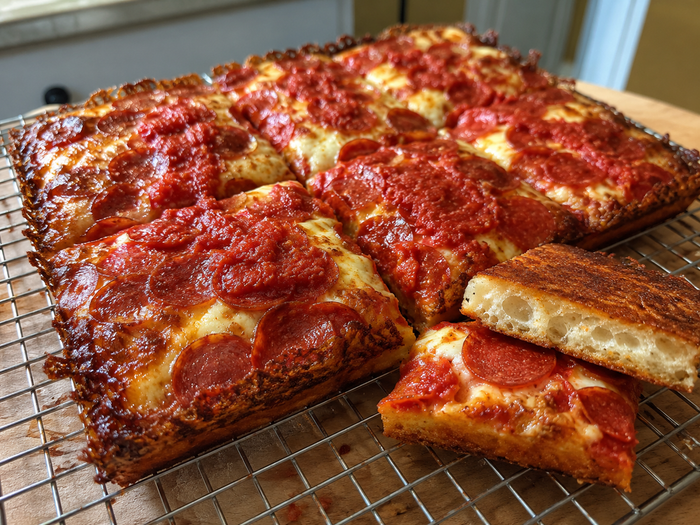
A few habits we've picked up over dozens of bakes that take a good sfincione to a great one. Once you've nailed this one, our homemade pepperoni pizza is another fun bake on the same hot steel.
- Pour real oil in the pan. That generous slick of olive oil is what actually fries the bottom, and it's authentic to the style. A few tablespoons across the pan beats a stingy brush every time.
- Toast your own breadcrumbs. The muddica is half the personality of this pie. Crumbs from stale bread toasted in oil with grated pecorino and oregano crisp into a golden top that store-bought crumbs can't match.
- Reach for high-gluten flour or a little diastatic malt. Both add chew and help browning. If browning is weak in your home oven, work in about 1% diastatic malt. If you're boosting all-purpose with vital wheat gluten instead, cap it around 1.5%, since more just turns the crumb tough.
- A steel gives the crispest bottom. Preheat it on a low rack at 500 to 550°F for 45 to 60 minutes, then bake the pan right on it. Our pre-seasoned carbon steel gives deck-oven floor heat at home. New to this? Start with getting a fresh steel ready and keeping the seasoning in good shape.
- Two optional one-offs. Run the cold pan over a stovetop burner briefly to pre-crisp the base, best with cast iron, never nonstick or thin aluminum that warps. Or prime the pan with shortening under the oil for easy release, though it costs olive-oil flavor. Oil alone usually releases clean.